
Where the Korean golfer went: Japan
Korean searches for golf in Japan hit a 26-week high this month, three and a half times the next destination. Domestic bookings on one of the big tee-time platforms are down a tenth, 430,000 Koreans have stopped playing in two years, and the demand that is left is pointing at Kyushu.
In the week of 9 November, Koreans searched for golf in Japan 7.7 times as often as they searched for "overseas golf" itself. That is a reading of 770 on GBR's destination index, the highest in the 26 weeks we track, up 14 percent on the week before and 30 percent above its six-month average. Japan has led the index in every one of those 26 weeks; its lowest reading, 479 in late July, was still above the best week any other country has had. What has changed this autumn is the size of the gap: Thailand, the second destination, reads 217, Vietnam 202.
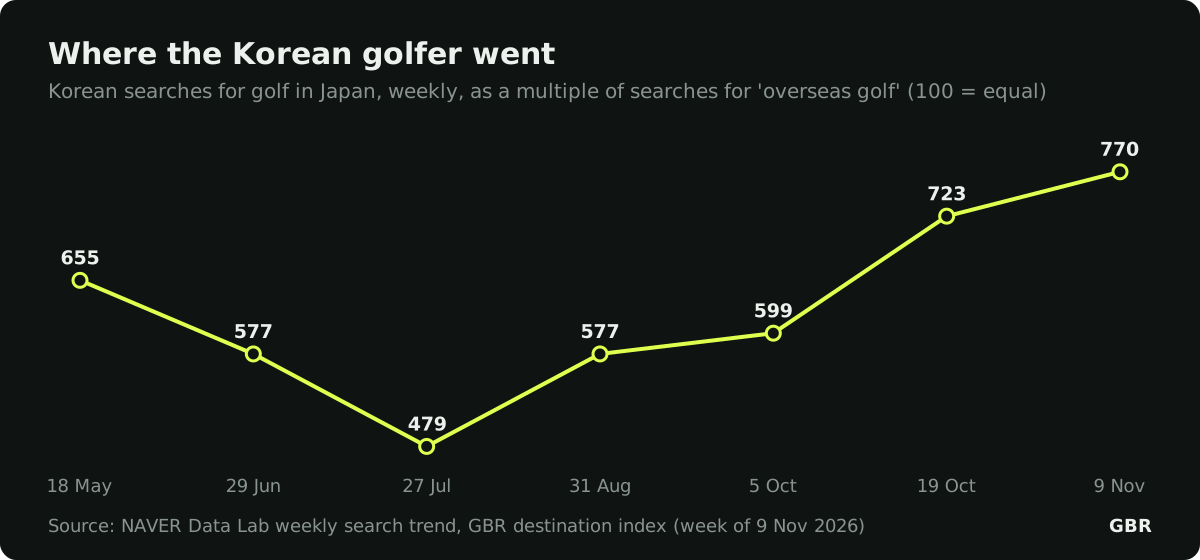 A summer trough and an autumn surge. Weekly Korean searches for golf in Japan, indexed to searches for "overseas golf" (100 = equal volume). NAVER Data Lab, GBR construction.
The search index is a leading indicator. The passenger counts and the bookings behind it say the same thing.
The numbers behind the search
Koreans are going to Japan in record numbers. The Japan National Tourism Organization counted 8,262,700 Korean visitors in the first nine months of 2026, up 21.6 percent on the year; September alone brought 842,300, a record for the month. The full-year record is 2025's 9,459,600, and at this year's pace of roughly 920,000 a month the count passes ten million before December, a first. In October, 2,945,694 passengers flew between Korea and Japan, a monthly record and 23.6 percent more than a year earlier.
Domestic golf bookings are falling while Japan bookings multiply. Shogolf, which runs the XGOLF tee-time platform, reported that bookings at Korean courses through XGOLF fell 10.1 percent between January and September. Bookings at the two golf-and-onsen resorts it owns in Kyushu, Satsuma in Kagoshima and Akamizu in Kumamoto, rose 162.6 percent between January and August. The report notes that the two figures cover different periods and that the Japan number partly reflects Shogolf's own expansion there. The direction is not in doubt.
Fewer Koreans play at all. The Korea Golf Association's 2025 golf participation survey, published in early November, puts the number of Koreans who played golf in the past year at 5.81 million, down from 6.24 million in 2023: 430,000 fewer golfers, a 7 percent fall in two years. The pool of non-golfers who say they intend to start shrank faster, from 10.0 million to 8.0 million. Among those who still play, the share of course visits made on weekdays rose from 48.1 percent to 62.2 percent, which is what a market does when weekend prices push out everyone who has a choice.
Why Japan
Price. GBR's weekend fee basket, the posted non-member 18-hole weekend rate at 42 public courses, has a median of ₩200,000 this week and has not moved since late October. Industry figures put weekday rates at the major courses around Seoul at ₩150,000 to ₩250,000 and weekend rates at ₩250,000 to ₩400,000, an estimated 30 to 60 percent above 2019. Add the caddie and the cart and a Saturday round comes to about ₩241,825 per person. Korean coverage of the Japan boom cites the weak yen as the other half of the equation.
Distance. Fukuoka is about an hour's flight from Busan and ninety minutes from Seoul. Airlines keep adding capacity into the smaller Kyushu airports that sit next to the courses: Jeju Air now flies to Kagoshima daily, and Korean Air four times a week to Oita.
Where in Japan. GBR's city-level index shows the demand concentrated in the south. Searches for golf in Kyushu (Fukuoka, Kagoshima, Miyazaki) read 254 this week, 88 percent above their six-month average. Okinawa reads 116, more than double its average. Hokkaido, the summer destination, has fallen to 3 as its season ends. GBR lists 1,946 golf courses in Japan from OpenStreetMap, nearly four times Korea's 510, with 76 in the Kyushu prefectures Koreans search for most and 37 in Okinawa.
Season. Korean courses in the north of the country lose weeks to the winter, and the destination index for every warm-weather country rises at this time of year: Vietnam is at a 26-week high and Thailand within 2 percent of one. Japan's rise is simply larger, and it started earlier, in the first week of October.
Who gains and who loses
The clearest winners are the Korean travel platforms that have moved into Japan. Shogolf holds 100 percent of its two Kyushu resorts, has put money into their fronts, rooms and carts this year, and says it is reviewing further acquisitions in Japan in 2027. Chosun Ilbo reported this week that even rural Japanese courses are now full of Korean groups.
For Korean course operators the picture is less comfortable. The weekday share of visits is rising, the player base is shrinking, and the first real price competition the industry has faced is a two-hour flight away. The posted weekend rates in GBR's basket have not moved since late October; where prices are giving way, it is on the booking platforms, which routinely sell the same tee times below the posted rate.
For Japanese regional operators, Koreans have become the inbound market. The Kyushu courses closest to Korea are the ones whose search demand has nearly doubled against its six-month average.
Why it matters outside Korea
Korea's golf market was worth ₩22.4 trillion in 2023, and its golfers pay about US$180 a head for a public weekend round at home. When they decide a round abroad is cheaper than a round at home, they move the market they land in. For anyone operating courses in Japan, Thailand, Vietnam or the Philippines, the Korean destination index is a weekly read on where that demand is heading before the bookings arrive.
What to watch next
- The Japan National Tourism Organization's October count, due in the second half of November, and the week the 2026 total passes ten million Korean visitors.
- Whether GBR's weekend fee basket moves off ₩200,000 as Korean courses enter the winter.
- Kyushu's reading on the Japan page through December.
- Shogolf's next acquisition in Japan, and whether other Korean platforms follow it across the strait.
Sources: GBR destination index from NAVER Data Lab weekly search volumes, week of 9 November 2026; GBR weekend fee basket, 16 November 2026; Japan National Tourism Organization arrivals for January to September 2026, released 21 October, via Travel Times (2 Nov 2026); Korea–Japan air passengers for October 2026 via News1 (13 Nov 2026); Shogolf and XGOLF booking data via Asia Today (20 Oct 2026) and Asia Economy (30 Oct 2026); Shogolf's Japan resorts and 2027 plans via Korea Economic Daily (12 Nov 2026); Korea Golf Association, 2025 Korea Golf Index, via Herald Economy and Asia Economy (2 Nov 2026); green fee ranges and the 2019 comparison via Asia Economy (30 Oct 2026); rural Japanese courses via Chosun Ilbo (13 Nov 2026); course counts from OpenStreetMap contributors; market size from the Korean Golf Industry White Paper 2024, via GBR's October 2026 story; US dollar conversion at ₩1,336 on 16 November 2026.