
The ₩286 million membership: how a tee time became an asset class
Korean golf club memberships trade on exchanges, carry a weekly price index and move with interest rates. The average of the 100 most-traded memberships is ₩286 million this week, 8 percent above a year ago and 29 percent above its late-2022 low.
In most countries a golf club membership is a subscription. In Korea it is closer to a security.
A membership at a members-only (hoewonje) course is a tradeable certificate. It is bought and sold through specialised exchanges, quoted weekly, and its price rises and falls with interest rates, the stock market and the mood of the country's business class. The best-known index, the Donga Golf Membership Exchange average of the 100 most-traded memberships, stood at ₩286.46 million on 26 October 2026, down 0.28 percent on the week, about 8 percent above the ₩265 million of August 2025 and 29 percent above the ₩222 million it touched in December 2022.
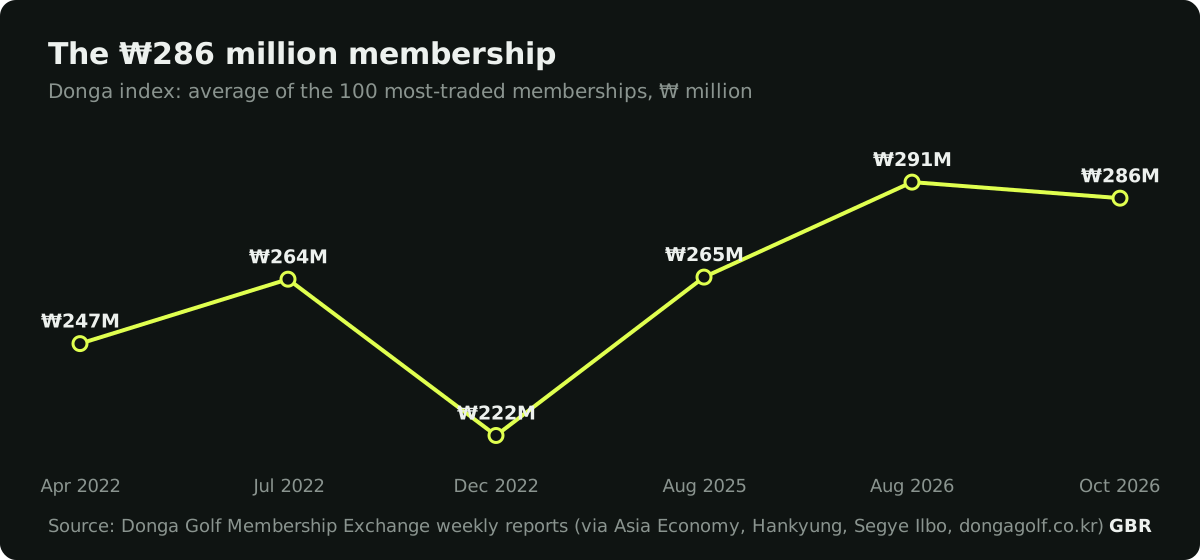 A full cycle in four years: the 2022 pandemic peak, the rate-driven slump, and the 2025–26 recovery. Donga exchange weekly reports.
What you are actually buying
A membership gives the holder, and usually a few named guests, the right to book tee times at member rates. At the top courses those rates are a fraction of the public price, and the booking priority is the real prize: a weekend tee time within an hour of Seoul can be nearly impossible to get without one.
The certificate itself is a deposit-style instrument. The club holds the money, the member holds the right to play, and the right can be sold to someone else. That is what makes a market. The top of it is far above the index: Nambu CC, south of Seoul, was quoted at about ₩2.56 billion for an individual membership this month, and East Valley at ₩2.57 billion, a price that would buy an apartment in most Korean cities.
Why prices move
Three forces drive the index, and the 2022–26 cycle shows all of them.
Interest rates. A membership ties up a large sum that earns no interest. When rates rose through 2022 the index fell from ₩264 million in July to ₩222 million by December; as rates eased and wealth rebuilt in 2025–26 it climbed back past ₩290 million in August 2026.
Corporate demand. Companies buy memberships for executives and client entertainment, and corporate certificates trade at a premium: the same Nambu membership is quoted at roughly double its individual price on the corporate board. When corporate profits are strong, so is demand.
Supply. Korea has 154 members-only course records in the national register, with 3,506 holes between them, against 375 public-course records. New members-only courses are rare, and some have converted to public status for the tax advantages. The pool of premium memberships is not growing.
The business behind the market
A handful of exchanges act as brokers, publishing bid and ask prices and taking a commission on each trade. Their weekly reports are read like stock-market summaries, with "top risers" lists and sector commentary. The same exchanges trade condominium and fitness memberships.
For the courses themselves, memberships are both capital and obligation. The deposits fund construction and upgrades, but they must be returned if a member exits and nobody takes their place, which is why a falling index is a balance-sheet problem for clubs, not just for members.
Why it matters outside Korea
Nothing like this exists at scale elsewhere. For an international operator it means Korean members are, in effect, investors who expect their asset to hold value; for a brand, the members-only courses are where the country's wealth concentrates on a Saturday morning; for an analyst, the index is a weekly read on the mood of Korea's business class that no survey matches.
What to watch next
- Whether the index holds above ₩280 million into 2027 if the Bank of Korea stays on hold.
- Members-only to public conversions, which shrink supply and tend to push the remaining memberships higher.
- The proposed cap on public-course green fees: if public prices are held down, the value of skipping the queue goes up.
Sources: Donga Golf Membership Exchange weekly market reports (26 Oct 2026, 12 Oct 2026, 10 Aug 2026; 2022 figures via Asia Economy, 2 Dec 2022, and Hankyung, May 2022); Donga individual and corporate price boards, October 2026; Ministry of Culture, Sports and Tourism golf course register, base date 31 December 2024.