
A ₩22 trillion industry with seven million players
Korea's golf market grew 8 percent in 2023 to ₩22.4 trillion, and most of that money is spent somewhere other than a fairway. What the industry's own white paper and the national participation survey say about where it goes, who plays, and what is shrinking.
Korea's golf industry was worth ₩22.43 trillion in 2023, up 8 percent from ₩20.8 trillion the year before, according to the Korean Golf Industry White Paper 2024 published by the Yuwon Golf Foundation and Seoul National University's Sports Industry Research Center. That is roughly $17 billion. More than seven million people in Korea play, in a population of about 51 million.
Those two headline numbers get quoted a lot. The structure underneath them is more interesting, because it explains why Korean golf behaves differently from every other large market.
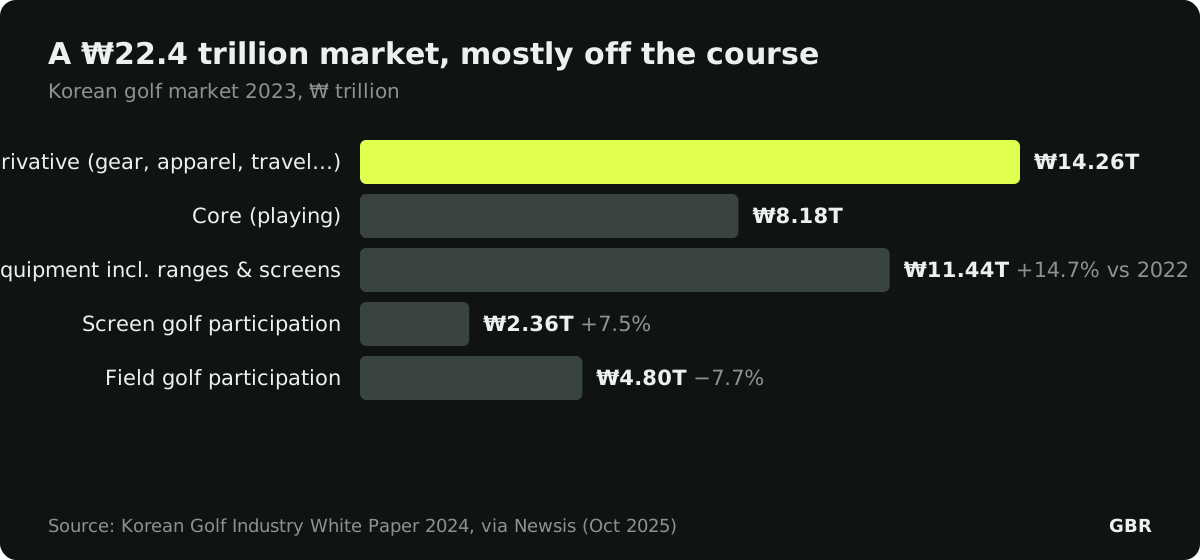 Nearly two-thirds of the money is "derivative": equipment, apparel, travel, media and simulators. White Paper 2024.
Where the money goes
The white paper splits the market in two.
| Segment | 2023 | Share |
|---|---|---|
| Core market (playing: courses and ranges) | ₩8.18 trillion | 36.4% |
| Derivative market (equipment, apparel, travel, media, screen and more) | ₩14.26 trillion | 63.6% |
Inside those, the lines that matter:
- Equipment, including ranges and screen facilities: ₩11.44 trillion, up 14.7 percent from ₩9.98 trillion in 2022. This is the largest single block and the fastest growing.
- Screen golf participation: ₩2.36 trillion, up 7.5 percent.
- Field (course) participation: ₩4.80 trillion, down 7.7 percent from ₩5.20 trillion.
Read together: in 2023 Koreans spent less on playing real courses and more on everything around the game, with indoor simulators and equipment carrying the growth. The white paper itself attributes the overall increase to screen participation, equipment, tourism and spectating offsetting a shrinking core.
Seven million players, counted three ways
Golf participation in Korea is measured by several bodies with different definitions, and the numbers are often mixed up.
| Measure | Figure | Source |
|---|---|---|
| Golfers (white paper definition) | more than 7 million | White Paper 2024 |
| Active golf population, 2023 | 6.24 million | Korea Golf Association, Korea Golf Index |
| On-course participation (visits) | 26.6 million | same |
| Off-course participation (ranges and screen) | 18.4 million | same |
| Average indoor screen visits per user | 14.5 a year | same |
| Course visits, 2025 | about 46 million, −2.1% | Korea Golf Course Owners Association |
The pattern is consistent across sources. The player base swelled during the pandemic, when overseas travel stopped and golf was one of the few things open, and younger players and women joined in large numbers. Since 2023 the outdoor side has been normalising: course visits fell in both 2024 and 2025, while the indoor and equipment sides have held or grown.
Why this market is different
Golf is a mass-market consumer business here, not a club sport. The derivative share, nearly two-thirds, is the tell. In most countries the course is the industry; in Korea the course is the smaller half.
Screen golf is an industry of its own. About 9,700 simulator rooms, led by Golfzon, turned golf into something you can do after work in any city for $12 to $16. They feed the rest of the market: people who start indoors buy clubs, book lessons and eventually go outside. Our feature on indoor golf has the detail.
Apparel is unusually large. Golf clothing in Korea is fashion. Several golf-apparel groups are listed companies, change collections every season and sell at department-store prices. Crisfnc, which owns Pinggolf, Pearly Gates and Master Bunny Edition in Korea, booked ₩312 billion in revenue in 2025.
Equipment is mostly imported, but one of the biggest brands is Korean-owned. The clubs and balls Koreans buy are overwhelmingly foreign, which is why GBR tracks golf club and ball imports monthly ($26.5 million in September 2026). Yet the parent of Titleist and FootJoy, Acushnet, is majority-owned from Seoul by Misto Holdings, formerly Fila Holdings.
Why it matters outside Korea
Korea is one of the five golf markets that matter, and the one that behaves least like the others. For an equipment brand it is a top export market with a demanding, fashion-led customer. For a course or resort operator it is a source of travelling golfers who are used to paying $180 a round and expect a caddie. For a simulator company it is the proof that indoor golf can be a mainstream business rather than a winter substitute.
What to watch next
- The 2026 edition of the white paper, due in 2027, which will show whether the 2023 crossover (screen up, field down) became a trend.
- The daejungje green-fee cap now being drafted, which would be the first direct price regulation of the core market.
- Equipment imports, GBR's monthly read on demand, after a −8.5 percent September.
Sources: Korean Golf Industry White Paper 2024 (Yuwon Golf Foundation and SNU Sports Industry Research Center), as reported by Newsis and Beyondpost, 23 October 2025; Korea Golf Association, 2023 Korea Golf Index (September 2024); Korea Golf Course Owners Association 2025 visitor survey (via Herald Economy, March 2026); Crisfnc 2025 results (company disclosure via FnGuide); Korea Customs Service via data.go.kr (GBR imports series); S-GOLF screen venue count (2024).